Never Miss a Beat - Get Updates Direct to Your Inbox
Topics:
FILTER:
Why Selling Your Business for a 4x Multiple Might Be a Mistake
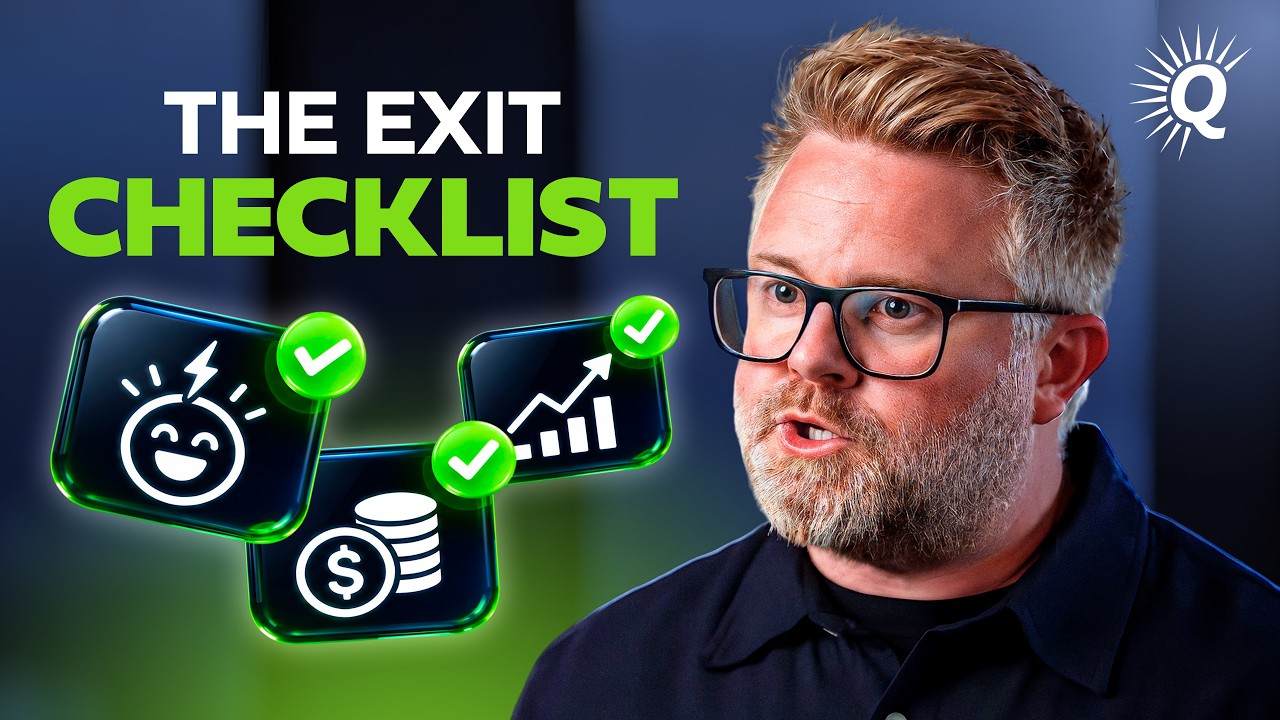

Are you genuinely ready to exit, or are you just completely burned out? Many founders make the biggest mistake of waiting until they are exhausted to sell, often walking away from millions in future cash flow. In this video, Quiet Light advisor Brad shares the 3-question exit checklist he uses to determine if you should sell your online business today, or hold onto it for maximum long-term wealth.
CHAPTERS
00:00 Is Now the Right Time to Sell Your Business?
00:45 The 3-Question Exit Readiness Checklist
02:15 Entrepreneur Burnout vs. Business Growth
03:30 How Interest Rates and Market Trends Impact M&A
04:45 How to Align Financial Goals With Market Timing
05:50 Single Points of Failure That Reduce Business Value
07:10 What Is Key Man Risk?
08:15 Understanding Business Valuations and Multiples
09:30 The Personal Side of Timing a Business Exit
TRANSCRIPT
00:00 Is Now the Right Time to Sell Your Business?
Let’s settle this once and for all. Is now the right time to sell your business? I hate to tell you this, but most founders get to me when they’ve already been completely burned out and don’t even want to look at their business anymore. Or maybe the business has peaked and now it’s coming down and they think, “Mhm, I know I talked to you whenever it was growing and I said, ‘I don’t know why I would sell right now, but now that it’s declining, I’m ready to sell yesterday.’ Unfortunately, this is something we see all the time. I have a little checklist that I like to use with sellers to see if they’re ready to sell or not. It’s pretty simple. I start with this.
00:45 The 3-Question Exit Readiness Checklist
When you wake up in the morning, are you excited to work on the business? Do you enjoy the work? If the answer is, “Yes, I enjoy it.” I think, “Okay. If you enjoy it, maybe you should stick with it. Why are you talking to me if you’re thinking you need to be exiting the business?” Number two, are the prospects for the future good? When I say this, I mean, like, if you think your business might be crushed by AI tomorrow, then your prospects for the future might not be good. But if you’re thinking to yourself, “No, I I really would uh believe that I’m going to do well tomorrow, next year, the year after that. I think I can grow this business. I think I can continue scaling it. I think I can reach new heights.” That’s a healthy sign. Maybe a good reason to stick around. The final question that I ask people is, do you need income? I know this might seem like a silly question, but I was a buyer one time, actually 26 times. And what I found through that process was that I would buy, operate, and then sell, and then after I sold, I would realize, “Oof, I’d really like to have that income back.” I wasn’t prepared to live on the nest egg from those sales for the rest of my life. So, it put me in a spot where I felt like well, I kind of need to get the business back. So, it started a vicious wheel of I need to go buy more. I need to go find something to do because I had sold my income machine. And you think about these questions. If you think, “You know what? I’m excited to get up and go to work tomorrow. I think my prospects for the future are good, and yes, I need income.”
02:15 Entrepreneur Burnout vs. Business Growth
If those things are true, you might want to just hold on to the business. If you find yourself thinking, “No, I don’t want to get up and look at this business anymore. I’m weary. I actually don’t want to look at this business anymore ever again.” If you find yourself feeling like, “I really need the income from this business. I don’t think I’m ready to live without the steady cash flow.” Or if you find yourself thinking, “The future does not look so bright.” It may not be the best time to consider selling your business. At Quiet Light, we have a team of entrepreneurs. We are entrepreneurs that have built, bought, and sold businesses. There’s 15 of us doing the advisory work. Take me as an example. I was a buyer 26 times. I bought 26 businesses. I operated those businesses. I went through all the same challenges that people like you were going through. I was a seller four times. In the last 8 years, I’ve closed 108 deals at Quiet Light. I’ve sat on all sides of the table, and I know what it’s like to be in your shoes. I’m going to walk you through a couple of signs, an internal sign and an external sign that you might be ready to sell or that maybe your business is not ready to sell.
03:30 How Interest Rates and Market Trends Impact M&A
Let’s start with an internal sign. One internal sign could be that you’re completely burned out. It’s really hard to account for burnout. If you’re feeling burned out, sometimes you can’t even get yourself out of bed to look at the business. So, we want to look at something like burnout very closely and see, how are you sort of weathering the day-to-day storm of running this business? An external factor. This might be something like, what is the market doing? We’ve seen over the last several years where interest rates have gone up very quickly. This did a lot of damage to the M&A market for both private equity and venture. That trickles down to even our deals in the sort of zero to 50 million space. So, an external factor might be, oh, well there’s not a lot of M&A activity going on. So, what does that mean it looks like to actually sell? These internal and external signs are things that can kind of point to whether it’s a good idea to think about selling now or maybe waiting for greener pastures. A lot of times when I meet with sellers, they have a financial number in mind. This is how much I want to sell my business for. Sometimes it’s represented by a number, sometimes it’s represented by a multiple, but a lot of times they’ll have a number in mind. One of the things we want to unpack is, how can we sort of measure ourselves to that number and figure out the right timing.
04:45 How to Align Financial Goals With Market Timing
You’ve got a number in mind, maybe it’s just a matter of executing towards that number. Maybe there’s a predictable way for us to figure out, okay, well, if you want to get to that number, you just need to continue growing the way you have been for the next 6 to 9 months and we’ll be there. We might have to have a tougher conversation like, hey, in the current form, it doesn’t look like that number is very realistic. So, you may not be able to achieve that unless something dramatically changes with the business. Or it might be something like, what’s the number today? Like, Brad, hey, if I just wanted to go to market right now, what does it look like? This may not be an ideal selling number, but it might be the number that allows you to overcome your burnout and move on to the next thing. We can help walk you through all of that. One of the biggest red flags we see in due diligence is a single point of failure. This can kind of show its head in a lot of different ways. One is, in a larger deal, key man risk. You a founder that the business is totally dependent on.
05:50 Single Points of Failure That Reduce Business Value
Think of it like the business is built on meta ads and the founder is a meta ads expert. And the buyer coming in doesn’t know anything about it meta ads. Think about the key man risk for a private equity deal. Is someone really going to write a check for $25 million when they think, “Well, wait a second. As soon as I give this seller this money, they’re going to be gone.” So, that would be key man risk. That’s a single point of failure. But, there’s other single points of failure. In smaller businesses, we see things like 60% of your traffic comes from a certain keyword that’s controlled by a Google algorithm. Sometimes we see that 60% of the sales come from a single SKU or ASIN. If that SKU or ASIN runs into trouble, it could be a problem. These single points of failure are a big red flag and they’re something to try to navigate and mitigate as a seller. I have found that the timing of selling your business is deeply personal. I did do this checklist earlier where we kind of went through, you know, is your business on steady ground? Is it going to have a good future? These different things. That’s a way of sort of getting a an internal read on it. But, timing is very personal. One of the things I say to a lot of people and they probably think, “Brad, you probably don’t have very much success in this work when you give people that advice.” But, I’ll say to them, “Look, hey, if you like running it and if the prospects look good and if you’re happy with the income that it’s generating, you should keep it.”
07:10 What is Key Man Risk?
Well, why would I say that? Well, just think about it. In a world where we’re going to trade your business for a two times, a three times, a four times, a five times, sometimes a six times multiple of what you earn. What does that actually mean? That’s the number of years of earnings we’re trying to get you. Let’s say it’s a four times multiple. We’re buying you four years worth of earnings. So, think about your business for a minute. Could your business be there in 20 years? Could you put the pieces in place for this business to last for a very long time? If you can, why would you sell it for four times today? Why would you give up potentially 20 years worth of income so that you can collect four years worth of income today? This is one of the things that we try to thoughtfully walk people through. Timing is very personal. It may be that you’re burned out. A lot of times entrepreneurs just are chasing something else. Hey, I’m in the I’m in the car speaker category and I want to be in supplements. I just can’t look at car speakers any longer. That’s okay.
08:15 Understanding Business Valuations and Multiples
If that’s your timing, then that’s your timing and we’ll work with you on it. But we also are not here to pressure you into selling when the time is not right. We want to remind you of the good thing you have built. You’ve built a business that is making you income. It’s giving you freedom. A lot of people that we talk to have immense amount of freedom to travel the world, to see people, to do the things that they want to do on their time, on their schedule. We want to embrace that, but we also want to encourage you to understand that the timing’s personal. We can’t make the decision for you. You’ve got to go through that door yourself. You’ve got to help us understand what timing is right for you. As I’m sure you can see, there’s a lot to this process. There’s a lot that goes into making the decision whether or not it’s time to sell or whether you should double down and keep holding on to the business. We’re here to help. We have checklists. We’ve got readiness assessments. We’ve got lines of questioning that we can take you through. We can help you walk through the process. And here’s the thing, when you schedule something with Quiet Light, there is zero pressure to go sell. We are interested in having the conversation, helping you understand. At Quiet Light, we are not just running a sales process. We are running a process based on experience.
09:30 The Personal Side of Timing a Business Exit
Whether you work with me or whether you work with one of the 14 other advisors at Quiet Light, you are getting someone who’s got real-world business experience, especially in the online realm. People that have built, bought, sold. People that have been in lawsuits. People that have dealt with their products disappearing overnight, or violations, or keywords disappearing, or traffic dropping, or traffic surging. We’ve seen it all. And since we’ve seen it all, we can advise you from a place of experience. We can be empathetic to the needs that you have as a seller, and we can help you get across the finish line. Our experience is our advantage. So, when you come to Quiet Light, just know we will guide you along. We’ll hold your hand through the process. We know how to coach you through it and get you through to the other side. Click the link and fill out the form, and we will help you get on the right path. Whether that means selling today, or never selling, or selling in 10 years. We’re here for it. Click on the link below, and we’d love to help you.