Never Miss a Beat - Get Updates Direct to Your Inbox
Topics:
FILTER:
What They Don’t Tell You About SBA Loan Underwriting
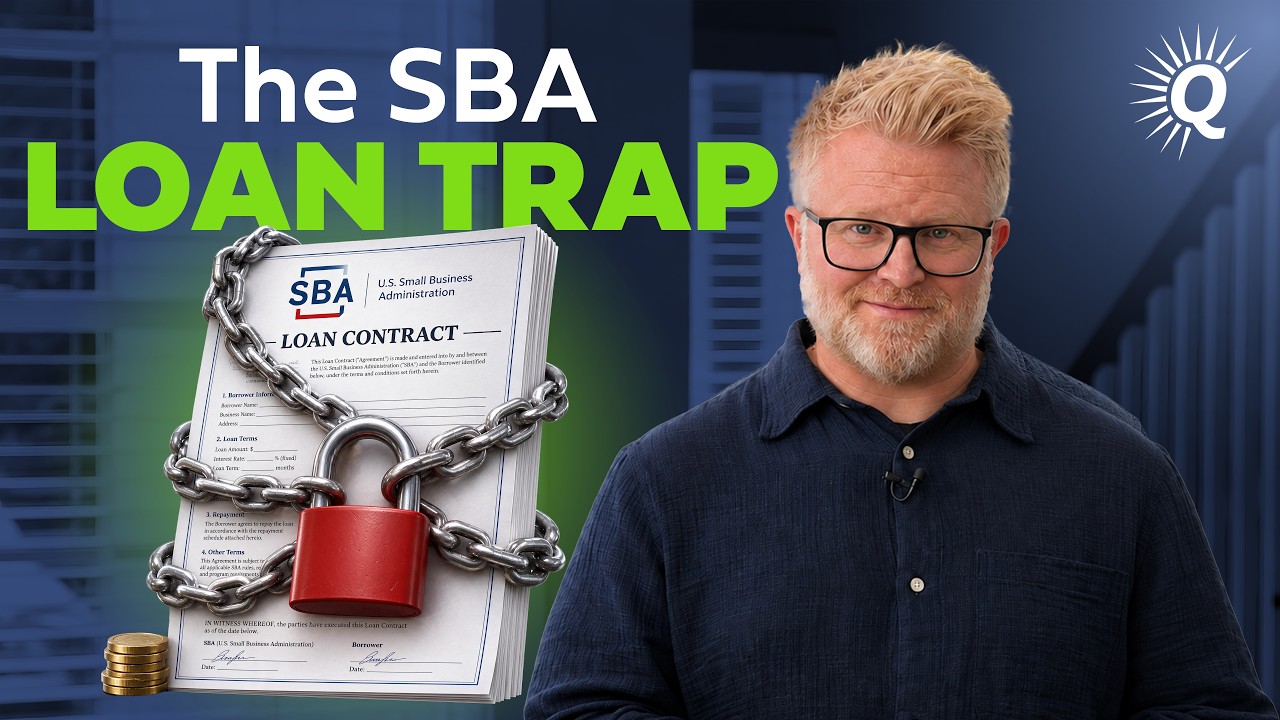

Are you planning to buy an online business using an SBA loan? Many entrepreneurs view the SBA loan as the ultimate vehicle for buying cash-flowing assets with little capital down. However, treating these financing tools as simple shortcuts ignores the complex underwriting mechanics required to close a deal. In this video, Brad discusses the reality of SBA business acquisition financing. Learn the strict eligibility rules, why 20%+ cap table owners must sign personal guarantees, and how sellers use SBA pre-qualification to spark high-priced cash bidding wars.
CHAPTERS:
00:00 The Reality of SBA Loan Acquisitions
01:25 Why SBA Financing Is So Popular
04:09 SBA Eligibility and Qualification Rules
07:49 The Danger of the Personal Guarantee
10:50 Why Sellers Must Clean Up Financials for SBA Qualification
11:44 How SBA Eligibility Changes Seller Strategy
TRANSCRIPT
00:00 The Reality of SBA Loan Acquisitions
Let’s talk about the reality of buying a business with an SBA loan. The pros, the cons, leverage, etc.
The internet is full of people talking about SBA loans as the ultimate vehicle for acquiring massive online businesses.
Sounds like the perfect setup. Acquire a cash-flowing asset with a fraction of the purchase price upfront.
But treating an SBA loan like a simple free-money tool without understanding the underwriting mechanics and the personal risks involved is incredibly dangerous.
At Quiet Light, we facilitate these transactions every single day. We know exactly how lenders underwrite these deals, what it actually takes for a buyer to get approved, and why sellers care about SBA eligibility.
Today, we’re going to break down the absolute reality of SBA financing, the pros, the cons, and how it completely changes the leverage in a negotiation.
Stick around till the end because I’m going to explain exactly why a smart seller will spend months doing the hard work to make their business SBA eligible, even if their ultimate goal is to only accept an all-cash offer.
Before you start shopping listings and thinking about taking on an SBA loan, you have to understand what this debt actually looks like.
Are you using leverage strategically to acquire a scalable foundation, or are you just chasing a low down payment?
01:25 Why SBA Financing Is So Popular
Let’s break down the SBA landscape. What is SBA financing, and why is it so attractive?
The SBA 7(a) program is the primary vehicle for business acquisitions.
The SBA does not directly lend the money. They guarantee a portion of the loan for an approved bank. This lowers the risk for the lender, allowing them to offer terms that do not exist in standard commercial lending.
For example, you can go buy a piece of commercial real estate for 15% down just about anywhere in the country.
On an SBA loan, there are many people buying businesses, even internet businesses, with just 10% down.
Better terms than a commercial property loan on real estate, which real estate’s like the holy grail of banking. All banking is sort of built on the real estate market.
So you get this SBA loan, maybe for as low as 10% down, and you get a repayment term of 10 years for the business acquisition.
So let’s just think about it. If you’ve shopped Quiet Light and you see listings, you might see listings listed at three times earnings, maybe four times earnings.
If you’re paying back over 10 years, then you’re creating excess cash flow. You’re buying for three or four times, you’re paying back over 10 years.
So it just creates an opportunity to pay the debt and make some money if you just pay the SBA’s minimum payment.
SBA deals are kind of known for requiring a 10% cash injection.
You’ll see lots of variance to this, so don’t take what I’m saying today as, like, this is exactly how it works with all banks. The banks make their own decisions.
So sometimes it’s 10% down from the buyer and a 10% seller note from the seller. Sometimes it’s 10% down.
The main point is you can buy a business and take a loan out for up to $5 million for as little as 10% down.
You can see why this program has become immensely popular.
It allows people to buy themselves out of the rat race, to buy themselves into a new category of wealth.
It allows people to feel like they are kind of upsizing their life.
They could go pay $250,000 for a business that costs $250,000, and maybe it’s making, you know, $50,000 or $60,000 a year.
Or they can go buy a business with that same $250,000 and get a $5 million business that might be earning a million dollars a year. And after they pay the debt service, they still have hundreds of thousands of dollars left over for themselves.
So you can see why these loans have become very important in our online business landscape.
04:09 SBA Eligibility and Qualification Rules
Qualifications and rules.
Okay, so buyers assume if the target business is highly profitable, the bank will approve the loan.
Several things to unpack there.
It’s a US program, SBA, Small Business Administration loan. So if you’ve got a business that’s located in Hong Kong, files tax returns in Hong Kong, is it eligible for an SBA loan?
No.
Okay, what if you have a seller who lives in the UK, but they have a US-based business? Is it eligible for an SBA loan?
No.
I’ve had people challenge me on that one. Never been able to see it work, so it’s probably not going to work.
So when you’re talking about SBA loans, you’re generally talking about a US-based business, a US-based buyer, a US-based seller. Those people coming together to do a deal.
Let’s talk about other qualifications.
Experience.
Just as little as five or six years ago, experience wasn’t a huge factor. They would lend to anyone who had the financial qualifications, but the banks got burned on that deal.
So now, if you’re selling a SaaS business and you’re a buyer that’s never run a SaaS business, they may reject it and say, “We don’t want to underwrite a loan for someone who doesn’t have any SaaS experience.”
So don’t think you can just borrow the down payment, buy a business from another country, and have no experience. You can’t do all those things.
It’s got a narrow scope, okay? And the scope of it is going to dictate whether it works or not.
So we can get a lot of businesses to fit inside that scope, but you need to understand, as a buyer, you’ve got to understand the rules.
The reason I’m focusing in on this so much is because I launch listings every day that say, “No, this is not SBA eligible.”
I even put a little note that says, “This is not SBA eligible because it’s not a US-based business.”
And you know what I get?
I get 50 emails during that process that say, “Hey, Brad, I know you said this is not SBA, but due to my interpretation of SBA rules, I think it can work.”
I have to tell them, “You know what? There might be instances where something that you’re talking about could work, but as a general rule, we’re not looking for a long-shot deal here.”
We want to go with SBA when it works well for the seller and well for the buyer, and the business can qualify.
All right?
So the 10%, let’s just say 10%. It might be 20%. It might be 50%. The seller can participate in that in certain instances.
So it’s not one-size-fits-all. Don’t think that it is.
You’ve got to think, there are hundreds of banks that offer SBA loans, and they all have their own different rules that fit inside the SBA’s framework.
So just kind of keep that in mind.
But you’re going to need to have some capital. Don’t come in to buy a business with an SBA loan and have no capital of your own.
You’re going to need to scrape together some kind of capital to get an SBA deal.
Another thing to mention on that is size.
People come to me on a $300,000 listing. They say, “Hey, Brad, why isn’t this SBA qualified? Could we do a deal for a $300,000 business with SBA?”
There are some things out there that would say that we could. But when you start to think about the timeline and how difficult these deals are to get through, a $300,000 deal is usually a better candidate for a cash buyer, just as a general rule.
And I’ll go beyond $5 million because let’s say I have a $7 million business, and I can get $5 million in SBA coverage.
Well, then all we’ve got to do is figure out what to do with that other $2 million.
You know, maybe the seller could do some seller financing. Maybe the buyer could put down a million.
So there are ways to work on larger deals and use that SBA $5 million limit on 7(a) loans.
07:49 The Danger of the Personal Guarantee
Here’s a problem. Buyers will treat SBA debt like an LLC corporate liability.
So they’re thinking to themselves, “Hey, I’ll sign up for this thing. If it doesn’t work out, that entity can file for bankruptcy, and I’m off the hook.”
Wrong.
SBA requires a personal guarantee.
Anyone on the cap table that owns 20% or more has an unlimited personal guarantee on this loan.
So you need to understand, if you go buy the business and you do not do a good job running it and you cannot make the payments, they’re coming after you.
They’re coming after your home. They’re coming after your capital. They’re coming after your cash accounts, investments, things like that. They’re coming after that to try to take it.
So you want to keep that in mind.
And I’ll just say one thing along this line because what I find is that buyers sort of seem to think of SBA loans as sort of like a lottery ticket.
Like, “Hey, I’m going to go sign up for $5 million in debt to the federal government of the United States.”
I get it that you’re seeing the opportunity of where you can go and how that’s going to benefit your life and all these things, but you do need to keep in mind, if you take out, you know, a $3.5 million SBA loan, you’re probably looking at a payment of around $50,000 a month.
Just think about that for a second. $50,000 a month.
If, for some reason, the business starts to struggle, that’s not the kind of money that most people just have, like, “Oh well, I’ll just cover it out of this little pile over here every month for the next 10 years.”
So you’ve got to really think about, do I want to carry this debt?
One of the things I’ve learned about SBA deals is that a lot of people are willing to jump straight into an SBA deal. They’re really excited to get the deal done, but they’ve never really tried on the reality of the $20,000, $30,000, $50,000, $75,000 a month that that business has to pay.
One of the things I encourage first-time buyers to do is, hey, the web business is a volatile world.
We see people make dreams up to a billion dollars. We see people crash down unglamorously on the way down. We’ve seen everything in between.
So one thing you want to keep in mind is how much cash do you have, and what’s your sleep-at-night factor?
If you actually try it on, you may not want to have a $2 million, $3 million, or $5 million SBA loan.
You might say, “Hey, I’ve worked hard for this $750,000. I can get a business that makes $200,000 a year, and if I buy it and the business cuts in half, I’m fine.
I still have an income. I still have a business. I’ve not risked my family’s future with the personal guarantee.”
So that’s just something to keep in mind.
Okay, so all these things, I’m talking about a lot of nuance here about different things about SBA.
One thing that you can rest assured in, we can get you set up with a competent SBA lender that can help us navigate current guidelines, what’s going on, what banks are doing.
So we work with different people that are sort of SBA loan brokers, and we know them well. And we actually, over time, have kind of optimized our own workflow to work with people who are good at getting them done.
So keep that in mind.
A competent SBA lender is going to allow you to figure out how much down payment do you need, how much seller financing, you know, is this a good fit, do you have the right experience, etc., etc.
One other factor as the buyer is working capital.
The SBA is going to want you to have working capital on hand. A lot of times, they’ll finance it into the loan.
So, you know, if you’re borrowing $3 million, they may say, “Hey, we think you need $300,000 just to kind of build a cushion in that account so that you can make the payments and still run the business.”
So there are other factors there as a buyer that you’ll want to kind of work through.
10:50 Why Sellers Must Clean Up Financials for SBA Qualification
Okay, so we’ve been talking about this mostly from the buyer side, but the introduction of SBA financing completely changes the dynamics for the seller.
Okay, so to be SBA qualified, a seller must have pretty immaculate and uncommingled financials, clearly separated entities.
You know, I’ve got to run this one business inside this one entity. I can’t have any other entities in there. I need to let a lot of that income flow down to the bottom line.
The business needs to have a lot of ordinary income.
And when we do this, when sellers put all these things together and get them lined up the way that we’re talking, the business shows income, the business is clean, it’s not commingled, it’s got several years of history, it’s flat, slightly growing, or slightly declining.
All those kinds of factors make for a good SBA loan.
If we get that and we can go out to market and say, “Hey, this business is available, only requires 10% down for most buyers,” that is a formula for creating a feeding frenzy on the listing.
Sometimes we’ll have as many as 20 SBA offers for a deal that’s clean like that.
So if you’re a seller and you’re wondering, should I maximize my earnings today and take more liberties on my tax return?
Well, if selling is important, you might want to pay more tax today, show more ordinary income so that you can get a better SBA deal when you sell it.
There’s a way to kind of thread the needle here and get the best of both worlds, but you want to be thinking about that.
Capital’s hard to come by for buyers. So if you have a business that’s going to be worth $3 million, $4 million, $5 million, $6 million, you’re going to want to be optimizing for SBA.
11:44 How SBA Eligibility Changes Seller Strategy
But whenever a seller structures their business to do well for an SBA loan, what they’re actually doing is creating the opportunity for cash buyers to come out with more intensity.
So let me give you an example.
We have a really clean SBA deal. The seller has everything kind of buttoned up. We package it up. We send it out. We get a bunch of SBA offers.
When those offers come in, then someone reaches out. They’re like, “Hey, Brad, I’m really interested in this listing. I want to buy it.”
And I say, “Well, we’ve got 10 SBA offers on it. You think you could pay cash?”
I’ve had this happen many times.
A buyer then says, “Well, that would make me competitive. I actually could pay cash.”
Okay, so what we’ve done now is we’ve used SBA to create the demand that then allows for a cash buyer to come in and scoop up the business.
So really, if you’re building a business that’s going to be $1 million to $10 million in enterprise value, optimizing it for SBA eligibility is a really good way to prepare yourself for an eventual exit.
Click the link in the description to view our vetted listings and speak with an advisor today.